Em suma, diversifique muito, pois o mercado de ações é regido pela Lei de Potência.
Hendrik Bessembinder has produced some of my favorite stock market research.
Bessembinder discovered that four out of every seven stocks in the U.S. have underperformed cash (one-month T-bills) since 1926. And just 4% of companies accounted for all the wealth gains for the entire stock market in that time.
The stock market runs on power laws over the long run.
Of course, there are stocks that do well over short time frames, but Bessembinder’s research highlights the benefits of diversification to ensure you take part in those big winners over time.
In a newly released research paper, Bessembinder goes deeper into the individual stocks that have experienced the biggest gains in market history.
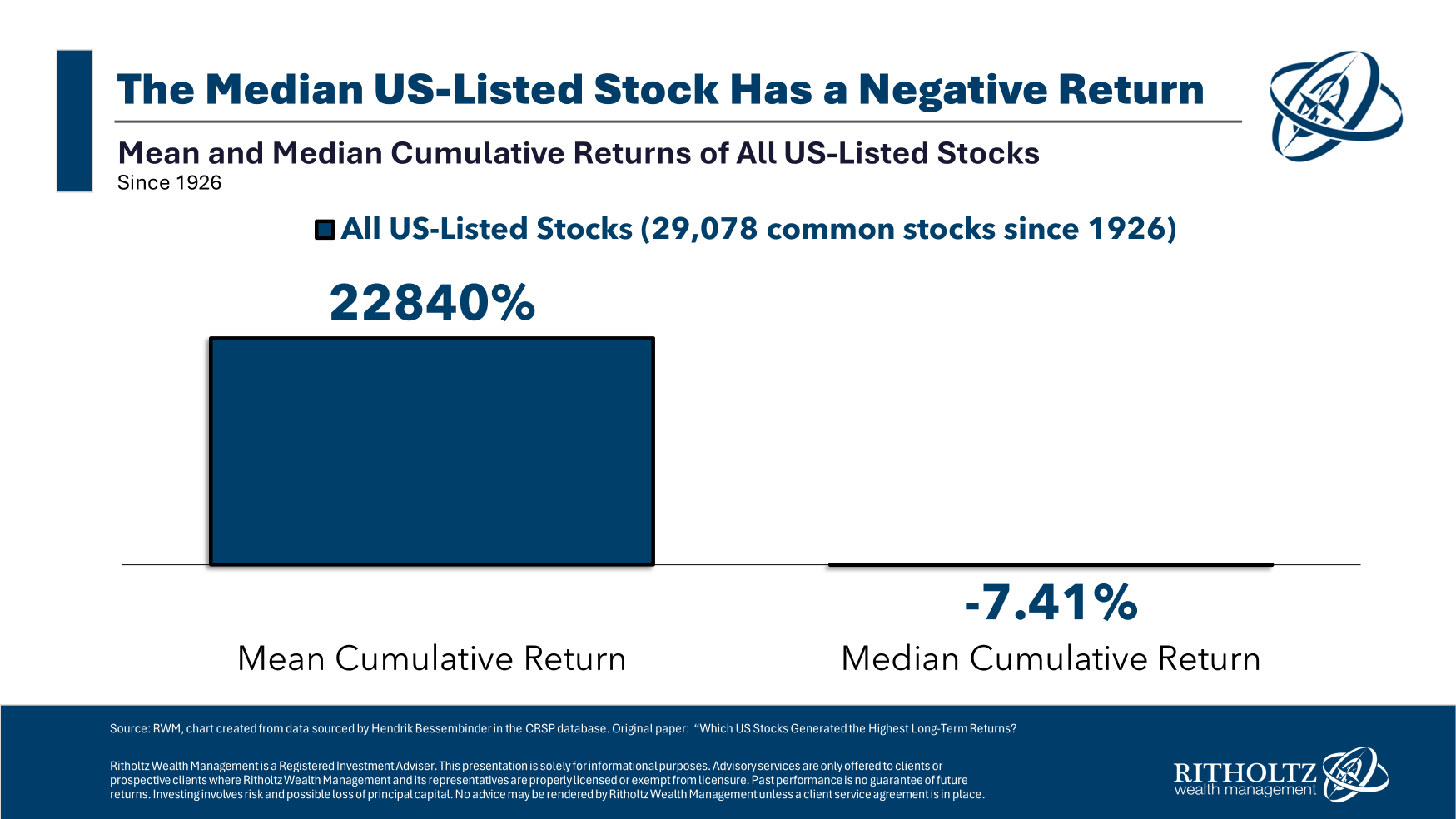
This was the stat that stuck out to me the most from this research: The average cumulative return going back to 1926 was nearly 23,000%, just a gargantuan number. But the median stock in that time experienced a cumulative return of -7.4%.
That’s a massive spread.
Remember, the median is simply the middle number of a group, which means more than half of all stocks have experienced negative returns.
The fact that the average return is so high reinforces Bessembinder’s earlier work about the *jargon alert* positive skew in the stock market. This tells you the best-performing stocks have experienced outsized returns relative to the rest of the market.
Most stocks are crap over the very long-run but the biggest gainers more than make up for the losers.
 The Biggest Winners in the Stock Market - A Wealth of Common Sense